On October 1 we walked into Propel PSU at Portland State University with thirteen other companies and started an eleven-week program. Yesterday the Oregon AI Accelerator announced its second cohort, and Airbrx is in it.
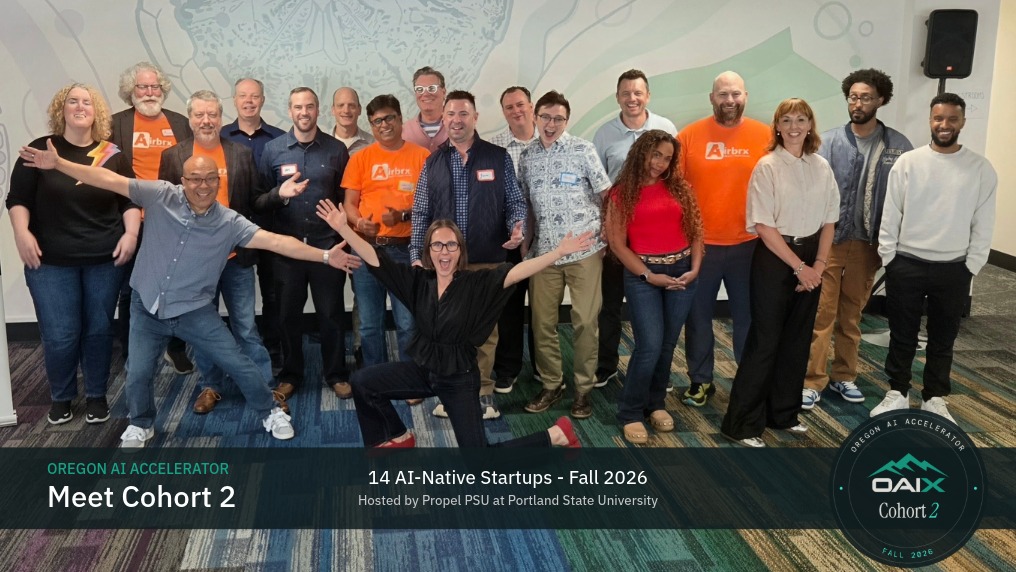
We're honored to be selected. But what excites us most isn't the selection itself. It's who's behind it.
Not a fund. A coalition.
Most accelerators are one organization with one network. That network might be very good, but it's one set of relationships, and it tends to point in one direction, usually toward the next round.
OAIX is a statewide public/private initiative. It's hosted by Propel PSU at Portland State, with Google as anchor sponsor, and it's supported by a coalition that reads like a map of Oregon's whole innovation economy: Portland State University, Oregon State University, OHSU, the University of Oregon, Business Oregon, the Oregon Entrepreneurs Network, the Technology Association of Oregon, TiE Oregon, and the Metro Region Innovation Hub.
Put those together and you get something a traditional accelerator can't offer:
- Research. Four of Oregon's major research universities, with expertise that runs from medicine to engineering to business, and plenty of people who will ask the questions a customer won't.
- Technology. An anchor sponsor that runs some of the largest data infrastructure on the planet.
- Enterprise. Industry associations and entrepreneur networks whose members are the companies running Snowflake, Databricks and Postgres bills every month.
- Economic development. State and regional organizations whose job is to make sure companies that start here can grow here.
And participation is equity-free. Founders don't give up ownership to take part. That tells you what the coalition is optimizing for: companies that work, in Oregon, not a portfolio.
What the program produces
Cohort 1 graduated 19 companies. Fourteen of those were generating revenue by Demo Day, four raised capital, and more than 350 people filled the room to watch them pitch.
Fourteen of nineteen with revenue is the number that matters to us. It says the program is built around customers, not slide decks, and that's exactly the help an infrastructure company needs.
Who else is in the room
Most of the founders in this cohort are (as the press release says) "applying AI to problems they know firsthand." There's a CPA who ran SOX audits for twenty years building AI agents for financial controls. A team keeping vaccines viable on off-grid delivery routes. An elementary school principal building the operating system for after-school programs. A former Intel general manager.
Airbrx is in the enterprise and AI infrastructure group, alongside Vantage Compute (automating GPU and HPC environments), Agile Integrations (quantum-inspired optimization on standard hardware), and Turtledown (version control and human approval for the specs AI coding agents build from). That last one is a cousin of what we do. They put a governance layer between coding agents and the spec; we put one between every tool and agent and the warehouse.
Which is one reason this cohort fits us so well: almost every company in it is building something that runs on data, and more and more of that data is read by agents. Agents ask the same questions over and over, and every repeat is billed. Fourteen AI-native companies is fourteen future warehouse bills. We'd like to be the reason those bills stay boring.
What we're doing with eleven weeks
The program meets in person at PSU every Tuesday and Thursday, with one-on-one mentoring from operators, investors and technical leaders in between. It's built around four things, and we have a concrete goal for each.
- Validate the market and the tech. Run the warehouse scan against as many real query histories as we can, and put the numbers in front of people who will argue with them.
- Enterprise pilots. Our pilot is about as low-risk as they come: point one tool at the gateway hostname and nothing changes. Queries pass through and get logged, and you turn caching up only where you want it. We want to run that with Oregon companies. We learn from every engagement and improve the product for all our clients.
- Strengthen the economics. We sell savings, so our own unit economics had better make sense. Eleven weeks of hard questions about that is a gift.
- Prepare for investment. Sharpen the story and tell it at Demo Day on Thursday, December 17, 2026. Whether we choose the investment route or not, getting the advice and review from people currently focused on the investment community is invaluable.
"Our job for the next eleven weeks is to help them move faster, sharpen their story, and put them in front of the people who can help them grow."
Jack Phan, Founding Director, OAIX
Why it matters past Demo Day
Airbrx is a Portland company. Not only do we get in front of researchers, technology leaders, investors and the people who sign for the warehouse bill right here in Oregon, but we get to give back a little too. We bring our international business experiences to our local community, and our local community, in turn, helps kick us into high gear to create a great, Oregon based company.
That's the room OAIX built. We're incredibly excited to be in it, and grateful to Jack, the Propel PSU team, Google, and every organization in the coalition that made it happen.
You don't have to be in Oregon, or even the US; if you run Snowflake, Databricks or Postgres, we'd love to have you as one of our pilots. Get in touch, or come say hello on December 17.
Sources
- Oregon AI Accelerator launches Cohort 2 with 14 AI-native startups from across the region · Oregon AI Accelerator
- The same release on EIN Presswire · EIN Presswire
- Oregon AI Accelerator · oregonaix.com